Who Is Emily Bell-Wootten and Why Her Approach to AI and Growth Strategy Matters Now

Who Is Emily Bell-Wootten and Why Her Approach to AI and Growth Strategy Matters Now
Emily Bell-Wootten has spent more than 20 years working across marketing, technology, customer experience and business growth, often at the point where companies are trying to figure out what comes next. As founder and CEO of EBW Consulting, she now works primarily with startups and mid-market companies building the systems they need to grow.
Her career has spanned more than 70 brands across 17 industries and work that has influenced more than $1 billion in revenue and pipeline growth. But she does not describe what she does simply as marketing. Her work tends to begin when a company has a good product, ambitious goals and a collection of disconnected pieces that are not yet working together.
That may mean marketing and sales are pursuing different customers. The CRM is full of bad data. The company has invested in technology that employees are not using. A founder is generating early revenue but has no repeatable go-to-market model. Or, increasingly, leadership has decided it needs AI without first deciding what problem AI is supposed to solve.
Bell-Wootten has seen this before.
She began working with emerging technology well before generative AI became part of the daily business conversation. Her early work included enterprise AI education and adoption with organizations including PepsiCo, McDonald’s, McCormick, Greyhound and Tenet Healthcare. The technology has changed dramatically since then. One lesson has not.
The technology is rarely the hardest part.
The harder work is understanding the business problem and getting the people, processes, data and systems around it to work together.
Building the Growth Engine Before Trying to Accelerate It
At EBW Consulting, Bell-Wootten focuses on go-to-market strategy and growth for technology companies, startups and mid-market businesses. Her work can include ICP definition, positioning, product marketing, demand generation, sales enablement, partnerships, customer experience, CRM, RevOps and AI adoption.
The breadth is intentional. Companies tend to organize these functions separately, while customers experience them as one company.
A business can generate plenty of leads and still have a growth problem if sales cannot convert them. It can have strong positioning and still struggle if it is aimed at the wrong customer. It can invest heavily in AI and automation only to discover that the data feeding those systems cannot be trusted.
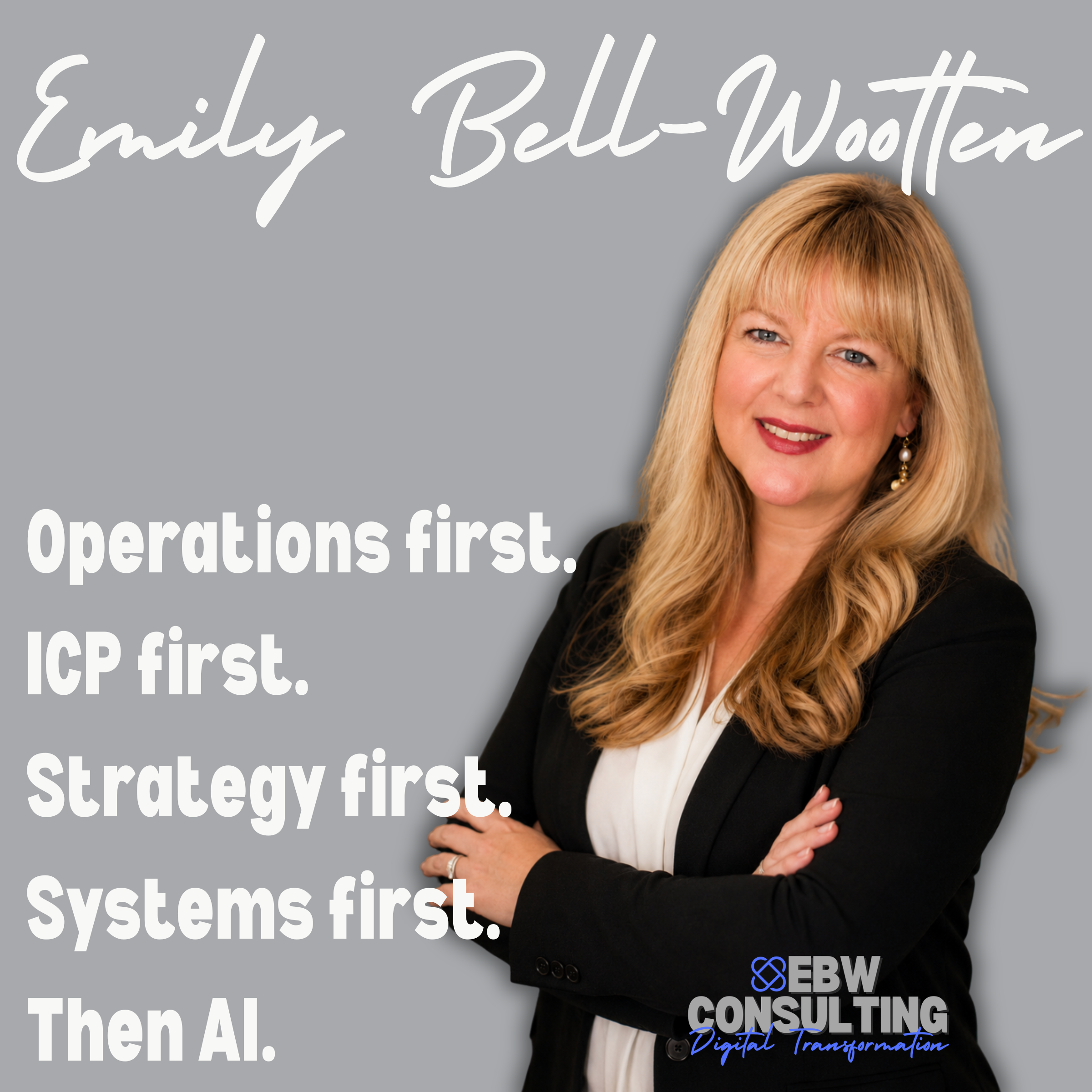
Bell-Wootten’s philosophy is straightforward: operations first, ICP first, strategy first, systems first. Then AI.
Companies often want to start with the tool because buying technology feels like progress. The harder conversation is whether the underlying organization is ready for it.
“If the CRM is a mess, adding an AI agent doesn’t suddenly make the data trustworthy,” Bell-Wootten says. “You’ve just given AI access to a mess.”
Why the Fractional Model Works for Growing Companies
The companies that bring in a fractional CMO are often at an awkward stage of growth. They are too large to continue operating on founder instinct and disconnected tactics, but not necessarily large enough to justify an experienced full-time executive and the team that typically comes with one.
That is particularly common in startups that have moved beyond proving that someone will buy the product. The next question is whether they can build a predictable system for finding, converting and retaining more of those customers.
Bell-Wootten has spent much of her career building those systems from the ground up. She has created CRM structures, messaging, campaigns, customer lifecycle programs, partnership models, sales tools, content libraries and the operating processes behind them. The strategy matters, but so does whether someone can actually make it work on Monday morning.
Her results offer some measure of that approach. She helped scale an enterprise customer experience practice from $2 million to $50 million in annual revenue and has supported transformation initiatives for more than 45 enterprise organizations.
At an SMB-focused AI marketing content company, she generated more than $1 million in pipeline and helped drive 51 percent growth within six months. She also worked on re-architecting the platform around an agentic AI model, reducing manual marketing and operational work by roughly 80 percent.
At a leading MSP/VAR in Dallas-Fort Worth, she increased pipeline by $7 million within 90 days. Other engagements have produced 1,856 qualified leads and early revenue within weeks for venture-backed companies, 50 percent year-over-year growth, an 80 percent increase in website traffic, a 140 percent increase in email engagement and campaigns generating five times their investment.
Those numbers matter to Bell-Wootten because they separate growth from activity. More content, more leads, more technology and more campaigns do not necessarily mean a company is getting healthier.
A Different View of AI Strategy
Bell-Wootten was an early advocate for AI in marketing, at a time when many marketers were deeply skeptical of it. Some dismissed the output as sloppy. Others worried that the technology would eventually eliminate jobs.
She believes the second concern deserves more attention than it often receives.
AI will replace some work that people do today, and smaller teams will increasingly be able to produce what once required much larger organizations. Bell-Wootten expects that shift to change marketing departments, agencies and professional services considerably.
But that is also why she argues against treating AI simply as a cost-cutting exercise.
Her approach to AI strategy starts with a question that has little to do with technology: What are we trying to make better?
AI can remove repetitive work and give people more time to think, create and solve harder problems. It can also be used to pile more work onto fewer employees without addressing whether that work matters.
“Human first. AI second,” is a phrase Bell-Wootten returns to often.
For her, it is less a rejection of automation than a standard for how it should be used. Technology should improve the business without losing sight of the people expected to use it and the customers the business exists to serve.
Why Dallas-Fort Worth Matters
More recently, Bell-Wootten has turned some of her attention toward the startup and technology ecosystem in Dallas-Fort Worth.
The region does not lack talent, capital or ambition. What Bell-Wootten sees missing is enough connective tissue between them.
AI has made it possible to build companies faster and with fewer resources. The ecosystem required to help those companies survive the transition from idea to traction and from traction to scale has not developed at the same speed.
Founders need more than funding. They need experienced operators, customers, mentors, universities, investors and other founders. Too often, Bell-Wootten says, someone is struggling with a problem alone that another person across town has already solved.
That belief has led her deeper into technology communities, founder initiatives, startup incubation and university partnerships alongside her consulting work.
She puts it more simply: community is not a side project. It is part of the infrastructure required for startup success.
Fix the Problem Before Buying the Solution
There is a question running through much of Bell-Wootten’s work, whether the conversation is about marketing, growth, customer experience or artificial intelligence: What is actually broken?
It sounds obvious. In practice, companies frequently skip it.
Before another AI platform, campaign, salesperson or consultant is added, Bell-Wootten wants leaders to know who their ideal customer is, why that customer buys, whether the positioning is clear, whether marketing is creating qualified pipeline, whether sales and marketing agree on what qualified means, whether the data can be trusted and whether employees can realistically execute the strategy.
If those pieces are unclear, technology will not solve the problem.
It may simply help the company get to the wrong answer faster.
That is ultimately the premise behind EBW Consulting: build the right foundation, connect the pieces that should be working together and then use technology to make the system better. https://www.emilybellwootten.com/
AI strategy | Go-to-Market strategy | Fractional CMO
Emily Bell-Wootten
Chief Marketing Officer | AI & Digital Transformation Strategist | Growth Executive at EBW Consulting
View all articles