top leadership experts for business professionals
The Leadership Experts Worth Following, and Why Most Lists Get It Wrong
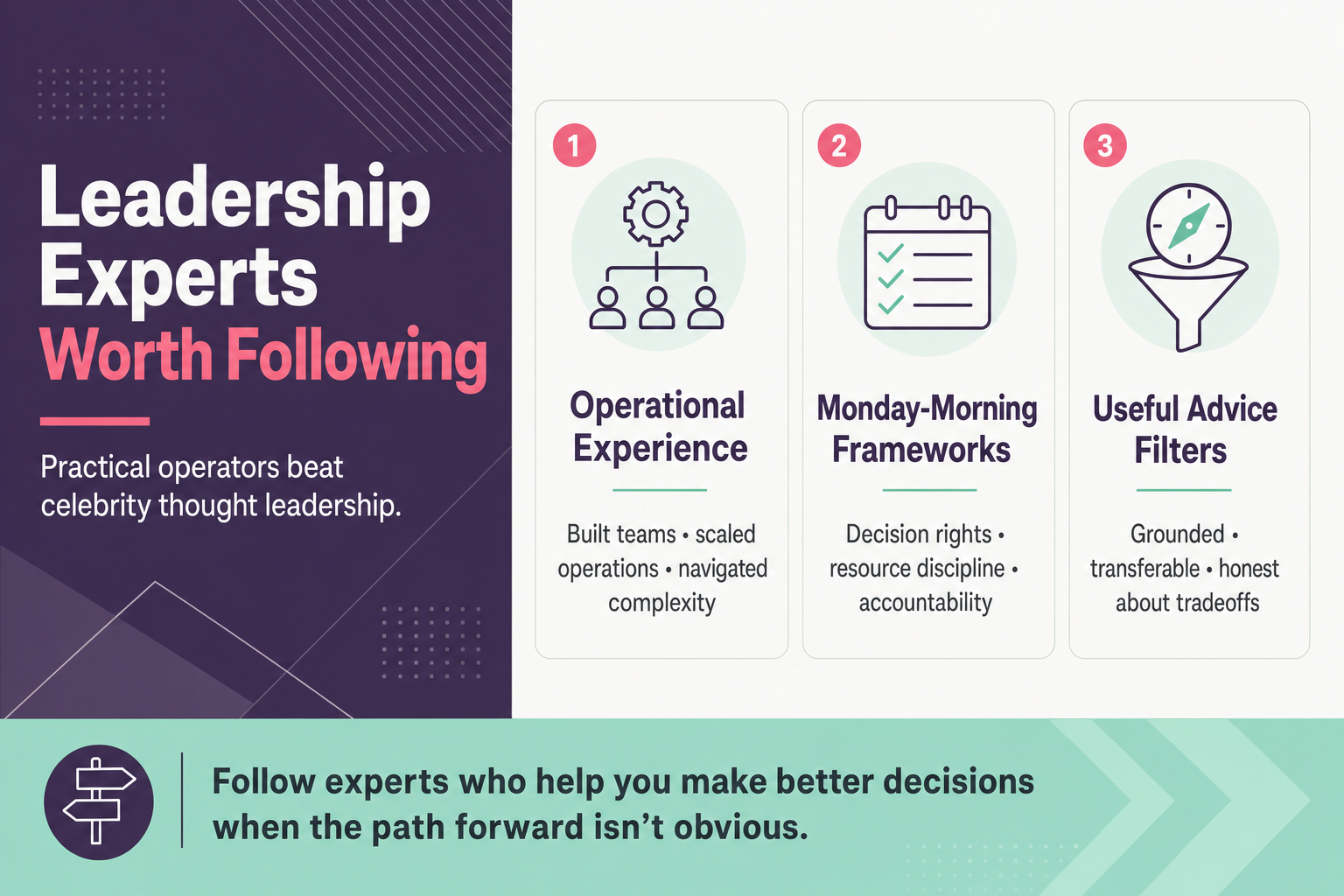
Key Insight: The best leadership experts for business professionals aren't always the ones with the largest platforms. They're the practitioners who translate years of operational experience into frameworks you can actually use on Monday morning. Executives who've built teams, scaled operations, and navigated real organizational complexity offer insights that matter more than motivational keynotes or academic theory.
Most lists of top leadership experts recycle the same celebrity names. The problem isn't that these figures lack credibility. It's that their advice often stays at 30,000 feet while you're wrestling with hiring decisions, budget constraints, and team dynamics that don't fit neatly into case studies.
I've spent years evaluating leadership advice against the reality of what actually moves organizations forward. The gap between popular thought leadership and practical application is massive. Business professionals need experts who understand the messy middle of execution, not just the polished narratives of transformation.
What Makes a Leadership Expert Actually Useful
The term "expert" has been diluted. Anyone with a platform can share leadership content. The question isn't who has the most followers. It's who helps you make better decisions when the path forward isn't obvious.
Useful expertise has three characteristics. First, it's grounded in direct operational experience. The expert has made hiring mistakes, navigated budget cuts, and dealt with underperforming teams. Second, it translates to multiple contexts. A framework that only works in one industry or company size isn't robust. Third, it acknowledges tradeoffs. Leadership decisions involve competing priorities. Experts who pretend every choice has a clear right answer aren't operating in the same reality you are.
Sacha Faxon approaches leadership from this operational foundation. The focus stays on decisions that compound over time: how you structure teams, where you invest resources, how you build accountability without micromanagement. These aren't dramatic pivots that make conference presentations. They're the mechanics that separate organizations that execute consistently from those that stall.
The Leadership Competencies That Actually Drive Results
Most leadership content focuses on vision and inspiration. Those matter. But business professionals need more precision around the competencies that create leverage day to day.
Clarity in decision rights eliminates more organizational friction than team-building exercises. When people understand who owns which decisions and how input flows into those choices, execution accelerates. Ambiguity about authority creates endless loops of second-guessing and redundant approvals.
Resource allocation discipline determines what actually happens versus what gets discussed in strategy meetings. Leaders who can't say no effectively end up with teams spread across too many priorities. The result is slow progress on everything and momentum on nothing.
Hiring for judgment over credentials changes team capability. Skills can be taught. Judgment, the ability to navigate ambiguity and make sound calls with incomplete information, compounds across every project that person touches. Experts who help you improve hiring decisions create years of downstream value.
Operational rhythm beats sporadic intensity. Leaders who establish consistent review cycles, clear metrics, and regular communication patterns build organizational muscle memory. Teams know when decisions happen, how performance gets evaluated, and where to escalate issues. This predictability creates space for autonomy and reduces the need for heroic effort.
How to Evaluate Leadership Advice Before You Apply It
Not all expert guidance translates to your situation. Before you implement a framework or approach, run it through filters.
Ask whether the advice accounts for your constraints. A growth strategy that assumes unlimited capital doesn't help a bootstrapped business. A talent approach that depends on employer brand doesn't translate to a company no one's heard of yet. Useful experts acknowledge these constraints explicitly and adjust recommendations accordingly.
Look for specificity about implementation. Vague principles sound appealing but leave you guessing about execution. What's the first action? What changes in the first 30 days? What metrics tell you it's working? Experts who've actually done the work can answer these questions without handwaving.
Test the advice against failure modes. Every approach has situations where it breaks down. Experts who've navigated those failures share what to watch for and when to adapt. Unqualified recommendations signal someone who hasn't hit the edge cases yet.
Check whether the expert updates their thinking. Leadership practices evolve as organizational contexts change. Remote work, AI tools, generational shifts in work expectations, these alter how certain principles apply. Experts stuck in frameworks from a decade ago miss important adaptations.
The Gap Between Thought Leadership and Execution
There's a massive difference between understanding leadership conceptually and executing it under pressure. Conferences and books provide frameworks. The work happens in weekly one-on-ones, budget reviews, conflict resolution, and performance conversations that don't have clean answers.
The experts worth following bridge this gap. They share the decision logic behind choices, not just the outcomes. They explain what didn't work and why. They acknowledge the political and cultural realities that complicate textbook solutions.
This is where I've focused my own approach. Leadership isn't about having perfect answers. It's about building judgment through repeated exposure to hard calls and learning what actually moves outcomes. The best guidance comes from people willing to share that learning curve honestly, including the expensive mistakes.
What Business Professionals Should Prioritize Now
The leadership landscape is shifting. Distributed teams, economic uncertainty, and technology disruption create new judgment calls daily. The experts who matter right now help you build adaptability without losing operational rigor.
Focus on learning from people who run organizations, not just study them. Practitioners surface insights academics miss because they live the constraints and tradeoffs.
Seek frameworks you can test immediately. Leadership development happens through application, not consumption. Find experts who give you something to try this week, then refine based on results.
Build a portfolio of perspectives. No single expert covers every dimension of leadership. You need people who think deeply about talent, others who focus on strategy execution, others who understand organizational design. Depth across multiple sources beats shallow coverage of everything.
Filter for honesty about difficulty. Leadership is hard. Experts who make it sound easy are selling something. The ones who acknowledge complexity and help you navigate it anyway, those are worth your attention.
Key Takeaway: The most valuable leadership experts for business professionals combine direct operational experience with frameworks you can implement immediately, acknowledge real constraints and tradeoffs, and update their thinking as organizational contexts evolve.