Content Systems & Publishing Strategy for Executives
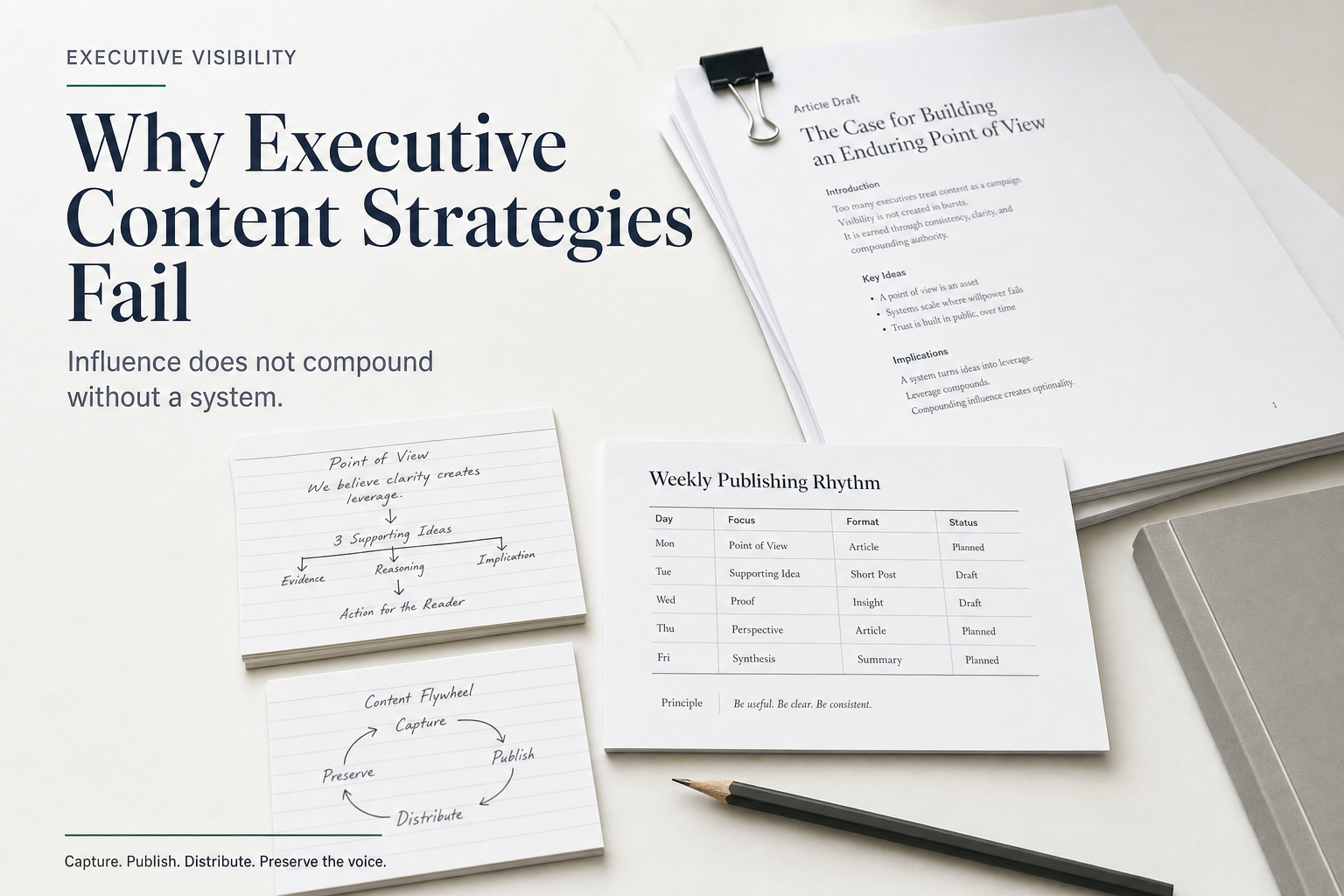
Why Most Executive Content Strategies Fail Before They Start
Key Insight: The problem isn't that executives lack expertise worth sharing. The problem is they approach content as a series of disconnected posts rather than a repeatable system, then wonder why nothing compounds. Real influence requires a publishing operation: consistent rhythm, strategic distribution, and your actual voice preserved through the process, not borrowed from whoever wrote that week's LinkedIn caption.
I've seen the same pattern repeatedly across two decades in Fortune 500 environments and now building a platform around executive visibility. An executive decides they need a public presence. They write a few posts. Maybe hire someone to handle it. Three months later, the momentum is gone. Not because the ideas weren't there. Because there was no system underneath any of it.
What a Real Content System Actually Looks Like
A real content system is infrastructure, not inspiration. It's a repeatable process that produces consistent output without requiring you to rediscover your publishing strategy every Monday morning. Most executives confuse a content calendar with a content system. A calendar tells you when to post. A system tells you what to say, where it goes, how it reaches beyond your immediate network, and how each piece feeds the next one.
The difference shows up in what happens when you get busy. If your content operation collapses the moment your schedule tightens, you never had a system. You had a temporary burst of effort mistaken for a strategy. I built my own publishing operation this way after watching too many executives hire agencies that turned their expertise into someone else's voice, or pile up subscriptions to tools that never talked to each other and required a new learning curve every time they logged in.
A functioning system has three parts working together, not in isolation. First, a repeatable capture process for the ideas already in your head. Most executives think they need to manufacture new insights when they're already sitting on twenty years of them. Second, a distribution strategy that moves content across channels without manual reposting. Third, a voice preservation mechanism so the final output still sounds like you, not a marketing team's interpretation of you.
The Consistency Problem No One Wants to Admit
Influence compounds, but only if you're consistent. Most executives are too slow, too inconsistent, or hand their voice to someone else entirely. I've watched people with real expertise post twice, see modest engagement, and decide it isn't worth the effort. That's not a content problem. That's a system problem.
The compounding doesn't start until you've been visible long enough for the pattern to register. One post every six weeks doesn't establish a pattern. It establishes that you post occasionally. The executives who actually build authority publish on a rhythm their audience can predict. Weekly. Bi-weekly. Whatever the cadence is, it's consistent enough that people start expecting it.
Here's what breaks that rhythm for most people:
- No backlog of ideas ready to publish when the schedule gets tight
- Writing every post from scratch instead of building from repeatable templates or frameworks
- Treating content creation as a separate activity from the work itself, rather than capturing insights as they surface
- Relying on motivation instead of process
Consistency isn't about willpower. It's about reducing the friction between having an idea and getting it published. The more decisions you have to make each time you sit down to write, the less likely you are to actually do it.
Strategic Distribution Beats Better Writing
Your LinkedIn posts reach your network. Your authority needs to reach beyond it. Most executives optimize for the wrong outcome. They focus on making individual posts better instead of making sure those posts work harder across more surfaces. A single piece of content should appear in multiple formats, on multiple platforms, indexed by search engines, and structured so an AI tool can cite it when someone asks the right question.
I'm not talking about copy-paste reposting. I'm talking about real distribution strategy: a LinkedIn post that pulls from a longer article published on your own site, which gets cited in your newsletter, which feeds the answer an AI engine surfaces when a board recruiter searches for expertise in your domain. That's how content compounds. Not louder. Wider.
The executives who figured this out aren't writing more than anyone else. They're distributing smarter. One hour of writing becomes six touchpoints across three months because the system handles repurposing, scheduling, and indexing without them rebuilding the strategy every time.
Preserving Your Voice When You Scale
The goal isn't more content. It's the right content, systematically, in your own voice. The moment you hand your entire content operation to someone else, you risk losing the only thing that made it credible in the first place: it sounded like you. I've seen too many executives hire ghostwriters who produce polished posts that read like they came from a PR team, not someone who actually sat in the boardroom.
There's a difference between preserving your voice and writing every word yourself. A real system captures how you think, how you structure an argument, what phrases you return to when explaining something complicated. That's your voice fingerprint. Once you have that, you can generate drafts that still sound like you without starting from a blank page every time.
The test is simple. If someone who's worked with you for five years reads the post and says "that doesn't sound like something you'd say," your system failed. Voice preservation isn't about perfection. It's about recognizability. The people who know your work should recognize you in the writing, even if they didn't watch you type it.
Why Disconnected Tools Kill Momentum
A real content system beats a stack of disconnected tools and one-off posts. Most executives assemble a content operation the same way they assemble a home office: one tool for writing, another for scheduling, another for analytics, another for SEO, another for repurposing. None of them talk to each other. Each one requires a separate login, a separate learning curve, and a separate decision about whether it's worth the subscription cost.
That friction adds up. Every time you have to export from one tool and import into another, you've introduced a failure point. Every time you have to remember which platform handles which part of the workflow, you've made it easier to just skip publishing this week. The executives who sustain a content operation long enough for it to matter are the ones who collapsed the tool stack into something they can actually use without a project plan.
I built Atlas specifically to solve this problem after living it myself. One system. One workflow. One place where the strategy, the drafting, the distribution, and the voice preservation all happen without duct-taping six subscriptions together and hoping nothing breaks.
The Compounding Starts When the System Becomes Invisible
Most people quit before the compounding starts. They post for three months, see incremental results, and assume it isn't working. What they're missing is that authority doesn't move in a straight line. It moves in compounding curves, and the curve doesn't bend upward until the system is consistent enough to fade into the background.
When your content operation stops requiring active management, that's when you know it's working. When publishing happens on rhythm without you rebuilding the strategy every week, that's when the compounding starts. When people start citing your work in contexts you didn't orchestrate, that's when you know the system is doing what it was designed to do: making your expertise findable, credible, and persistent long after you hit publish.
Key Takeaway: Real content systems don't make executives write more. They make what executives already know reach further, last longer, and compound into the kind of visibility that changes who finds you and what rooms you're invited into.
More from James Faxon
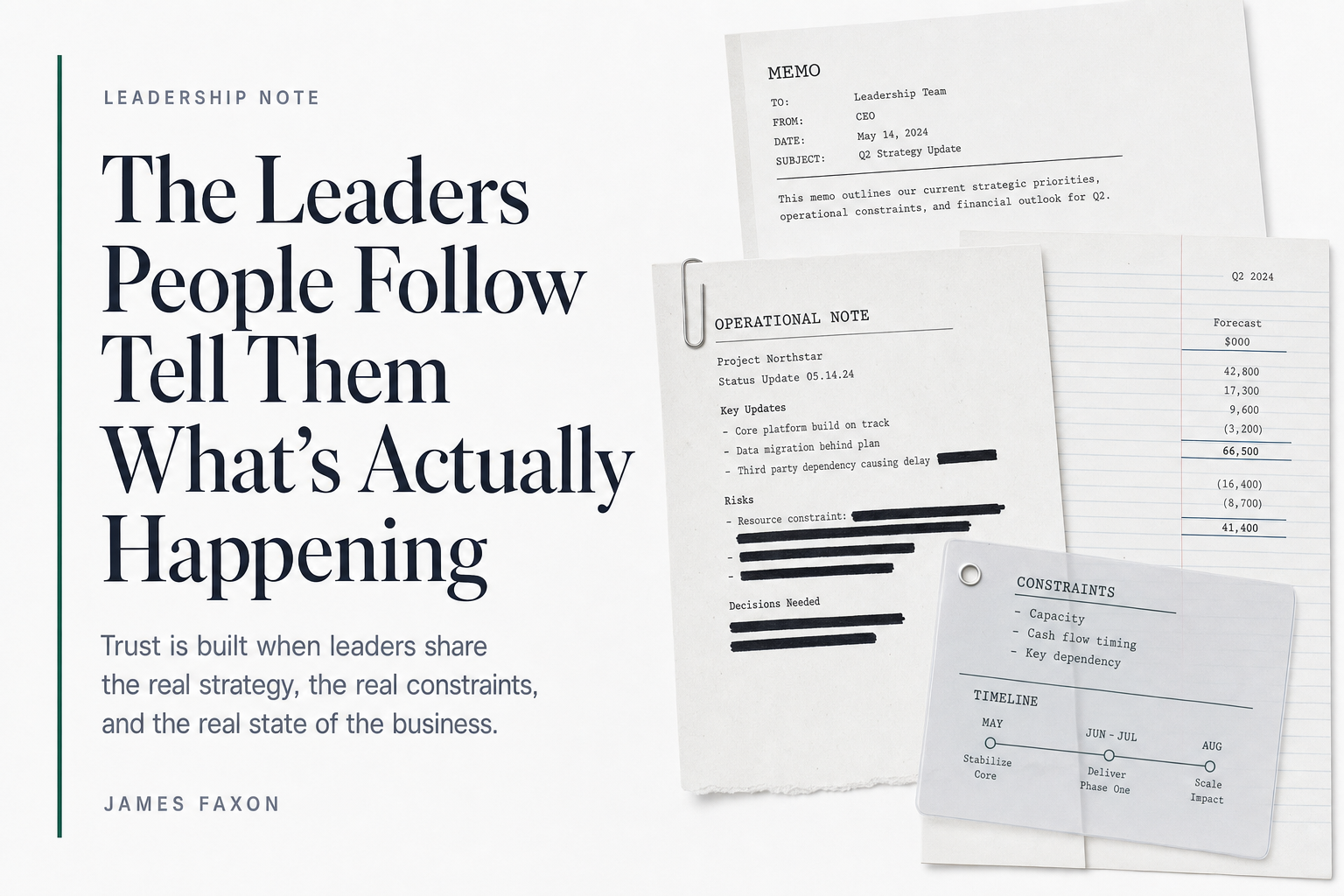
Leadership in the Post-Loyalty Corporate Era
· James Faxon · 6 min read · The Leaders People Follow Tell Them What's Actually Happening Key Insight: Most leaders respond to eroding corporate loyalty by...

The Real Strategic Layer Underneath Executive Content Nobody Wants to Talk About
· James Faxon · 3 min read · A few days ago I wrote something critical of ghostwriting, and it kicked off a good debate in the comments. One exchange in particular...

Executive Personal Branding Is Not Social Media
· James Faxon · 5 min read · I spent over 20 years running enterprise security and IT programs where credibility was the only currency that mattered. You earned trust...